Today, FreePress.net lists six companies that control most of what Americans read, hear, and see in the media.
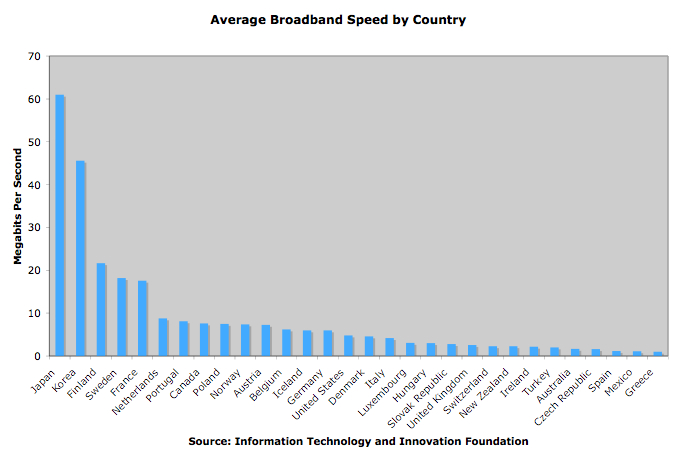
We also discussed Internet speeds across the globe. According to Jamaipanese.com, the United States places 23rd in the race for the fastest Internet speeds:
 |
| (click on the image to view it at full-size) |
I was really shocked to find the United States ranked so poorly in regards to Internet speeds, especially because I actually believed that our Internet was relatively fast. While the WiFi capabilities on campus are less than stellar, I have never been disappointed by the speeds that I receive at my home. I cannot imagine how fast the Internet must be in places like Japan, Korea, and Finland.
In a YouTube video from Diggnation, the show's hosts discuss the differences between Internet speeds in Japan versus the United States. The hosts, who claim to be paying for speeds of 30 megabits per second, find that their speeds top at about 4 to 18 megabits per second. (Ignore the quirky behaviors and profanity.)
In searching for more information about Internet speeds, I found an article from February 2011 on the Huffington Post regarding the Internet in South Korea. According to the New York Times, as quoted in the article:
"By the end of 2012, South Korea intends to connect every home in the country to the Internet at one gigabit per second. That would be a tenfold increase from the already blazing national standard and more than 200 times as fast as the average household setup in the United States."The article points out additional differences between the Internet in the United States and the services available in South Korea. While Americans pay an average of $46/month for "comparatively slow service," South Koreans "who enjoy above-average connection speeds of 100 megabits per second" pay just $38/month.
Overall, today's class enlightened me on just how behind the United States is with Internet technology. It's interesting to consider how often America is regarded as a "technologically-advanced" country, when in actuality, 22 other countries are racing right past us.

No comments:
Post a Comment