I've always loved NMATV's animated videos that attempt to explain issues in the news. I stumbled upon this video from last week regarding SOPA. While watching the video might make it difficult to take the bill seriously, it does pack all of the news surrounding the issue into a clearer, more cohesive package.
Sunday, December 4, 2011

Public Broadcasting
In Thursday's class, we discussed public broadcasting, both in the United States and around the world. I was really intrigued by Prof. Cohen's information regarding the coverage of the Iraq war. According to Cohen, during the time leading up to the war, the public broadcasting system's coverage was nearly as slanted as the mainstream coverage.
I was also fascinated by the statistics that Cohen offered regarding on-air guests. While most of the United States was in support of withdrawing troops from Iraq, the public broadcasting system remained biased in its coverage: for every one supporter in favor of withdrawing troops, PBS was required to air five people who said that we should stay in Iraq.
I must admit that I was a bit surprised by these statistics regarding public broadcasting. Prior to this discussion, I had assumed that PBS would at least be a bit less slanted than the mainstream media. Learning that even public broadcasting was a victim of the government's agenda was, admittedly, a bit shocking.
Cohen argued that the United States needs to instill insulated funding as a means of protecting the media. Insulated funding guarantees money regardless of the station's coverage; this would, in essence, allow media agencies to say whatever they'd like without fear of being shut down.
I found a 'Letter to the Editor' by Patrick Butler, president and CEO of the Association of Public Television Stations, on the Washington Post that breaks down the numbers regarding public broadcasting. There were quite a few interesting statistics in Butler's letter:
I was also fascinated by the statistics that Cohen offered regarding on-air guests. While most of the United States was in support of withdrawing troops from Iraq, the public broadcasting system remained biased in its coverage: for every one supporter in favor of withdrawing troops, PBS was required to air five people who said that we should stay in Iraq.
I must admit that I was a bit surprised by these statistics regarding public broadcasting. Prior to this discussion, I had assumed that PBS would at least be a bit less slanted than the mainstream media. Learning that even public broadcasting was a victim of the government's agenda was, admittedly, a bit shocking.
Cohen argued that the United States needs to instill insulated funding as a means of protecting the media. Insulated funding guarantees money regardless of the station's coverage; this would, in essence, allow media agencies to say whatever they'd like without fear of being shut down.
I found a 'Letter to the Editor' by Patrick Butler, president and CEO of the Association of Public Television Stations, on the Washington Post that breaks down the numbers regarding public broadcasting. There were quite a few interesting statistics in Butler's letter:
➤ "Public broadcasting represents a little more than one-hundredth of 1 percent of the federal budget."It's really fascinating to see how little American public broadcasting is funded in relation to other countries. Knowing this information, it certainly makes sense to follow through with the financial plan that Cohen proposed in class: three or four tiny taxes would make American public broadcasting more financially supported than the BBC.
➤ "Public broadcasting costs about $1.35 per citizen per year in America, a tiny percentage of comparable figures, among them $31.13 in Canada, $67.34 in Japan, and $85.52 in Great Britain."
SOPA and its Implications for Indy Media
The Stop Online Piracy Act, or SOPA, is a new bill that hopes to stop online copyright infringement by cracking down on social media websites like Facebook, Twitter, YouTube, and Tumblr. Under the bill, companies and copyright holders could order court injunctions that ask for the immediate removal of websites which allegedly "encourage" piracy.
If passed, SOPA would completely change our Internet experience as we know it. According to an article on the Huffington Post, the bill would mean that all websites with user-generated content would have "no choice but to pre-screen every posting to comply with the law." The implications of this requirement are tremendous: According to statistics on Twitter, the service handles over one billion tweets every week.
SOPA has gained national attention since Internet giants like Google, Yahoo, and Facebook announced their disapproval of the proposed legislation. Regardless of the objection, court decisions are already being made based on the bill's standards. Last month, a Nevada judge ordered the immediate shutdown of over 228 websites, asking that their "domain names [be] transferred and their listings [be] removed from search engines."
The case centered around fashion company Chanel, which "investigated 228 sites it suspected of counterfeiting goods, ordered from 3 of them, internally confirmed the counterfeit, and then extrapolated from that. The judge ordered all 228 domains to be seized." The above news article on this case offers an interesting point:
For the sake of the Internet, freedom of information, freedom of speech, and freedom from censorship, I sincerely hope that SOPA is left on the Senate room floor.
If passed, SOPA would completely change our Internet experience as we know it. According to an article on the Huffington Post, the bill would mean that all websites with user-generated content would have "no choice but to pre-screen every posting to comply with the law." The implications of this requirement are tremendous: According to statistics on Twitter, the service handles over one billion tweets every week.
SOPA has gained national attention since Internet giants like Google, Yahoo, and Facebook announced their disapproval of the proposed legislation. Regardless of the objection, court decisions are already being made based on the bill's standards. Last month, a Nevada judge ordered the immediate shutdown of over 228 websites, asking that their "domain names [be] transferred and their listings [be] removed from search engines."
The case centered around fashion company Chanel, which "investigated 228 sites it suspected of counterfeiting goods, ordered from 3 of them, internally confirmed the counterfeit, and then extrapolated from that. The judge ordered all 228 domains to be seized." The above news article on this case offers an interesting point:
"It is unclear how and why this Nevada judge purports to exert powers over hundreds of separate defendants internationally and order relief from parties only tangentially related to the case, such as search engines."Internet censorship at its finest? I certainly believe so. It seems not only unfair, but illegal for a judge to punish all 228 domains for the actions of three, especially because neither Chanel nor the court confirmed that the remaining 225 domains were counterfeiting goods for profit. It is easy to see how this cases parallels to SOPA's jurisdiction: under the bill, any website which is even suspected of participating in piracy or copyright infringement will immediately be served a cease-and-desist order.
For the sake of the Internet, freedom of information, freedom of speech, and freedom from censorship, I sincerely hope that SOPA is left on the Senate room floor.
Tuesday, November 29, 2011
Media Regulation and Internet Speeds
In today's class, we discussed media regulation. I was intrigued by the timeline that Prof. Cohen offered on this topic, especially in regards to changes in the 7-7-7 rule. In an effort to promote diversity in the media, the government originally ruled that one could only own seven television stations, seven AM radio stations, and seven FM radio stations. In the 1970s, however, the government began ruling against diversity and in favor of a more concentrated media.
Today, FreePress.net lists six companies that control most of what Americans read, hear, and see in the media.
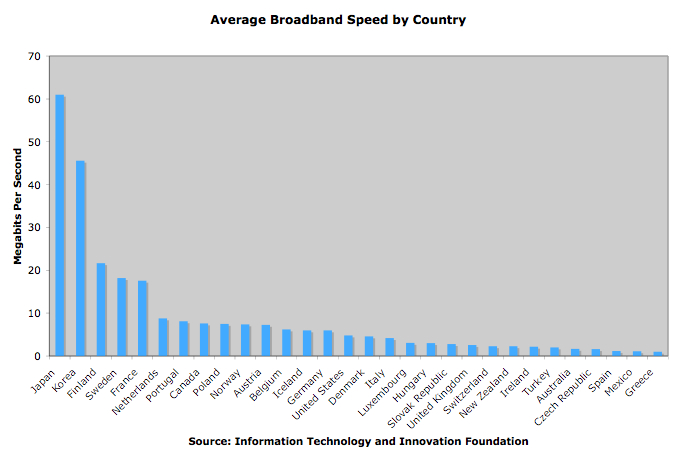
We also discussed Internet speeds across the globe. According to Jamaipanese.com, the United States places 23rd in the race for the fastest Internet speeds:
I was really shocked to find the United States ranked so poorly in regards to Internet speeds, especially because I actually believed that our Internet was relatively fast. While the WiFi capabilities on campus are less than stellar, I have never been disappointed by the speeds that I receive at my home. I cannot imagine how fast the Internet must be in places like Japan, Korea, and Finland.
In a YouTube video from Diggnation, the show's hosts discuss the differences between Internet speeds in Japan versus the United States. The hosts, who claim to be paying for speeds of 30 megabits per second, find that their speeds top at about 4 to 18 megabits per second. (Ignore the quirky behaviors and profanity.)
In searching for more information about Internet speeds, I found an article from February 2011 on the Huffington Post regarding the Internet in South Korea. According to the New York Times, as quoted in the article:
Overall, today's class enlightened me on just how behind the United States is with Internet technology. It's interesting to consider how often America is regarded as a "technologically-advanced" country, when in actuality, 22 other countries are racing right past us.
Today, FreePress.net lists six companies that control most of what Americans read, hear, and see in the media.
We also discussed Internet speeds across the globe. According to Jamaipanese.com, the United States places 23rd in the race for the fastest Internet speeds:
 |
| (click on the image to view it at full-size) |
I was really shocked to find the United States ranked so poorly in regards to Internet speeds, especially because I actually believed that our Internet was relatively fast. While the WiFi capabilities on campus are less than stellar, I have never been disappointed by the speeds that I receive at my home. I cannot imagine how fast the Internet must be in places like Japan, Korea, and Finland.
In a YouTube video from Diggnation, the show's hosts discuss the differences between Internet speeds in Japan versus the United States. The hosts, who claim to be paying for speeds of 30 megabits per second, find that their speeds top at about 4 to 18 megabits per second. (Ignore the quirky behaviors and profanity.)
In searching for more information about Internet speeds, I found an article from February 2011 on the Huffington Post regarding the Internet in South Korea. According to the New York Times, as quoted in the article:
"By the end of 2012, South Korea intends to connect every home in the country to the Internet at one gigabit per second. That would be a tenfold increase from the already blazing national standard and more than 200 times as fast as the average household setup in the United States."The article points out additional differences between the Internet in the United States and the services available in South Korea. While Americans pay an average of $46/month for "comparatively slow service," South Koreans "who enjoy above-average connection speeds of 100 megabits per second" pay just $38/month.
Overall, today's class enlightened me on just how behind the United States is with Internet technology. It's interesting to consider how often America is regarded as a "technologically-advanced" country, when in actuality, 22 other countries are racing right past us.
Tuesday, November 15, 2011
Ethics in Indy Journalism
Today's class focused on the ethics of independent journalism, and there were quite a few interesting points raised by Prof. Cohen and my classmates.
One of the biggest ethical dilemmas centered on Mayhill Fowler, a blogger for Huffington Post. Fowler gained access to one of Obama's political conferences that was closed to the mainstream media. After noting that others were recording the speech, Fowler broke out her own audio recorder.
During his speech, Obama referenced small town Pennsylvanians who become "bitter" and "cling to guns or religion" in response to the current state of our politics. Fowler caught it on tape, and realizing that Obama's comments could potentially be used against him, she published his entire speech so that readers could view the sentiments in their full context.
The dilemma is whether Fowler was ethically correct in recording the speech, let alone publishing it online.
I agree with many of the comments made in class regarding this issue. It is a journalist's duty to keep the government in check, not to protect politicians for fear of losing access to them. In this sense, I believe that Fowler did the correct thing by publishing the transcript.
I also agree with Prof. Cohen's argument that a politician should not be allowed to get away with saying one thing to one group of people, like large investors, and another thing to another group of people, like small-town voters. It's a journalist's job to make sure these types of discrepancies do not occur.
While Fowler took plenty of heat for publishing the article, I commend her bravery for both recording the speech and choosing to publish it online. I think her actions were admirable, and she certainly did the right thing by not burying the story merely because Huffington Post is so strongly pro-Obama.
One of the biggest ethical dilemmas centered on Mayhill Fowler, a blogger for Huffington Post. Fowler gained access to one of Obama's political conferences that was closed to the mainstream media. After noting that others were recording the speech, Fowler broke out her own audio recorder.
During his speech, Obama referenced small town Pennsylvanians who become "bitter" and "cling to guns or religion" in response to the current state of our politics. Fowler caught it on tape, and realizing that Obama's comments could potentially be used against him, she published his entire speech so that readers could view the sentiments in their full context.
The dilemma is whether Fowler was ethically correct in recording the speech, let alone publishing it online.
I agree with many of the comments made in class regarding this issue. It is a journalist's duty to keep the government in check, not to protect politicians for fear of losing access to them. In this sense, I believe that Fowler did the correct thing by publishing the transcript.
I also agree with Prof. Cohen's argument that a politician should not be allowed to get away with saying one thing to one group of people, like large investors, and another thing to another group of people, like small-town voters. It's a journalist's job to make sure these types of discrepancies do not occur.
While Fowler took plenty of heat for publishing the article, I commend her bravery for both recording the speech and choosing to publish it online. I think her actions were admirable, and she certainly did the right thing by not burying the story merely because Huffington Post is so strongly pro-Obama.
Friday, November 11, 2011
Bloggers, Links and Plagiarism
Today, blogger Jim Romenesko — a staple at Poynter for over 12 years — resigned from his job after being accused of inadequately attributing quotes in his blog posts. According to Poynter's director, Romenesko would often copy and paste entire sections of news articles, and although he linked to the original sources, he did not enclose the copied information in quotation marks.
Bloggers and media critics have responded to Romenesko's departure with both harsh criticism and support. The response I found most interesting, however, came from Steve Buttry at the Journal Registry Company. Buttry argues that in an Internet era, linking to a source is the new in-text attribution.
The digital era is different, and I believe that it calls for us to reconsider the old habits and ideas of citations and plagiarism. In printed text, we can't link to sources. The ability to create a link, however, has revolutionized the idea of giving credit. Links create an easy-to-navigate, digital works cited page right within the body of the article or report. There's no need for messy parenthetical citations of authors, page numbers, and years, and no need to flip to the end of the report to hunt down a source.
It's simpler; it's cleaner; and it's certainly a lot easier to find the source of information.
Romenesko should have added quotation marks around the information he copied; it is the ethical thing to do, and it distinguishes between the blogger's voice and another author's writing. However, I agree with Buttry's standpoint: Romenesko's lack of quotation marks is not indicative of plagiarism, because he never failed to link to a source. His resignation over the matter seems like an extreme response to a minor offense.
Bloggers and media critics have responded to Romenesko's departure with both harsh criticism and support. The response I found most interesting, however, came from Steve Buttry at the Journal Registry Company. Buttry argues that in an Internet era, linking to a source is the new in-text attribution.
"I agree that Romenesko — and any journalist — should use quotation marks when using exact words of people. But when you credit and link, failure to quote is not plagiarism. It's a punctuation offense, not a serious breach of journalism ethics."At first thought, the idea of literally copying and pasting text from articles or sources seems like it warrants some sort of reprimand. We've been taught since we could write that all of the information that we use in papers and projects must be cited according to the rules of MLA or APA. Neglecting to cite information (or neglecting to use the appropriate commas and periods on the works cited page) constitutes plagiarism. Plain and simple.
The digital era is different, and I believe that it calls for us to reconsider the old habits and ideas of citations and plagiarism. In printed text, we can't link to sources. The ability to create a link, however, has revolutionized the idea of giving credit. Links create an easy-to-navigate, digital works cited page right within the body of the article or report. There's no need for messy parenthetical citations of authors, page numbers, and years, and no need to flip to the end of the report to hunt down a source.
It's simpler; it's cleaner; and it's certainly a lot easier to find the source of information.
Romenesko should have added quotation marks around the information he copied; it is the ethical thing to do, and it distinguishes between the blogger's voice and another author's writing. However, I agree with Buttry's standpoint: Romenesko's lack of quotation marks is not indicative of plagiarism, because he never failed to link to a source. His resignation over the matter seems like an extreme response to a minor offense.
Thursday, November 10, 2011
Good News for Net Neutrality
In Tuesday's class, we discussed the idea of net neutrality, a term that perhaps PC Magazine best defines:
So what's the good news?
In an article posted on the Washington Post earlier today, the Senate voted to uphold net neutrality, a huge victory for, well, basically everyone except the media conglomerates.
A level playing field for Internet transport. It refers to the absence of restrictions or priorities placed on the type of content carried over the Internet by the carriers and ISPs that run the major backbones. It states that all traffic be treated equally; that packets are delivered on a first-come, first-served basis regardless from where they originated or to where they are destined.It is interesting to consider how different our Internet experience would be were it not for this concept. The "Big Six" media conglomerates — General Electric, Walt Disney, News Corp., Time Warner, Viacom and CBS — dominate much of our online content; however, we still have equal access (at the same download speeds) to all other outlets, including independent media forms with opinions that may not jive with those of the Big Six. The absence of net neutrality would toss this equal access into question.
So what's the good news?
In an article posted on the Washington Post earlier today, the Senate voted to uphold net neutrality, a huge victory for, well, basically everyone except the media conglomerates.
Subscribe to:
Posts (Atom)