I've always loved NMATV's animated videos that attempt to explain issues in the news. I stumbled upon this video from last week regarding SOPA. While watching the video might make it difficult to take the bill seriously, it does pack all of the news surrounding the issue into a clearer, more cohesive package.
Sunday, December 4, 2011

Public Broadcasting
In Thursday's class, we discussed public broadcasting, both in the United States and around the world. I was really intrigued by Prof. Cohen's information regarding the coverage of the Iraq war. According to Cohen, during the time leading up to the war, the public broadcasting system's coverage was nearly as slanted as the mainstream coverage.
I was also fascinated by the statistics that Cohen offered regarding on-air guests. While most of the United States was in support of withdrawing troops from Iraq, the public broadcasting system remained biased in its coverage: for every one supporter in favor of withdrawing troops, PBS was required to air five people who said that we should stay in Iraq.
I must admit that I was a bit surprised by these statistics regarding public broadcasting. Prior to this discussion, I had assumed that PBS would at least be a bit less slanted than the mainstream media. Learning that even public broadcasting was a victim of the government's agenda was, admittedly, a bit shocking.
Cohen argued that the United States needs to instill insulated funding as a means of protecting the media. Insulated funding guarantees money regardless of the station's coverage; this would, in essence, allow media agencies to say whatever they'd like without fear of being shut down.
I found a 'Letter to the Editor' by Patrick Butler, president and CEO of the Association of Public Television Stations, on the Washington Post that breaks down the numbers regarding public broadcasting. There were quite a few interesting statistics in Butler's letter:
➤ "Public broadcasting represents a little more than one-hundredth of 1 percent of the federal budget."It's really fascinating to see how little American public broadcasting is funded in relation to other countries. Knowing this information, it certainly makes sense to follow through with the financial plan that Cohen proposed in class: three or four tiny taxes would make American public broadcasting more financially supported than the BBC.
➤ "Public broadcasting costs about $1.35 per citizen per year in America, a tiny percentage of comparable figures, among them $31.13 in Canada, $67.34 in Japan, and $85.52 in Great Britain."
SOPA and its Implications for Indy Media
The Stop Online Piracy Act, or SOPA, is a new bill that hopes to stop online copyright infringement by cracking down on social media websites like Facebook, Twitter, YouTube, and Tumblr. Under the bill, companies and copyright holders could order court injunctions that ask for the immediate removal of websites which allegedly "encourage" piracy.
If passed, SOPA would completely change our Internet experience as we know it. According to an article on the Huffington Post, the bill would mean that all websites with user-generated content would have "no choice but to pre-screen every posting to comply with the law." The implications of this requirement are tremendous: According to statistics on Twitter, the service handles over one billion tweets every week.
SOPA has gained national attention since Internet giants like Google, Yahoo, and Facebook announced their disapproval of the proposed legislation. Regardless of the objection, court decisions are already being made based on the bill's standards. Last month, a Nevada judge ordered the immediate shutdown of over 228 websites, asking that their "domain names [be] transferred and their listings [be] removed from search engines."
The case centered around fashion company Chanel, which "investigated 228 sites it suspected of counterfeiting goods, ordered from 3 of them, internally confirmed the counterfeit, and then extrapolated from that. The judge ordered all 228 domains to be seized." The above news article on this case offers an interesting point:
For the sake of the Internet, freedom of information, freedom of speech, and freedom from censorship, I sincerely hope that SOPA is left on the Senate room floor.
If passed, SOPA would completely change our Internet experience as we know it. According to an article on the Huffington Post, the bill would mean that all websites with user-generated content would have "no choice but to pre-screen every posting to comply with the law." The implications of this requirement are tremendous: According to statistics on Twitter, the service handles over one billion tweets every week.
SOPA has gained national attention since Internet giants like Google, Yahoo, and Facebook announced their disapproval of the proposed legislation. Regardless of the objection, court decisions are already being made based on the bill's standards. Last month, a Nevada judge ordered the immediate shutdown of over 228 websites, asking that their "domain names [be] transferred and their listings [be] removed from search engines."
The case centered around fashion company Chanel, which "investigated 228 sites it suspected of counterfeiting goods, ordered from 3 of them, internally confirmed the counterfeit, and then extrapolated from that. The judge ordered all 228 domains to be seized." The above news article on this case offers an interesting point:
"It is unclear how and why this Nevada judge purports to exert powers over hundreds of separate defendants internationally and order relief from parties only tangentially related to the case, such as search engines."Internet censorship at its finest? I certainly believe so. It seems not only unfair, but illegal for a judge to punish all 228 domains for the actions of three, especially because neither Chanel nor the court confirmed that the remaining 225 domains were counterfeiting goods for profit. It is easy to see how this cases parallels to SOPA's jurisdiction: under the bill, any website which is even suspected of participating in piracy or copyright infringement will immediately be served a cease-and-desist order.
For the sake of the Internet, freedom of information, freedom of speech, and freedom from censorship, I sincerely hope that SOPA is left on the Senate room floor.
Tuesday, November 29, 2011
Media Regulation and Internet Speeds
In today's class, we discussed media regulation. I was intrigued by the timeline that Prof. Cohen offered on this topic, especially in regards to changes in the 7-7-7 rule. In an effort to promote diversity in the media, the government originally ruled that one could only own seven television stations, seven AM radio stations, and seven FM radio stations. In the 1970s, however, the government began ruling against diversity and in favor of a more concentrated media.
Today, FreePress.net lists six companies that control most of what Americans read, hear, and see in the media.
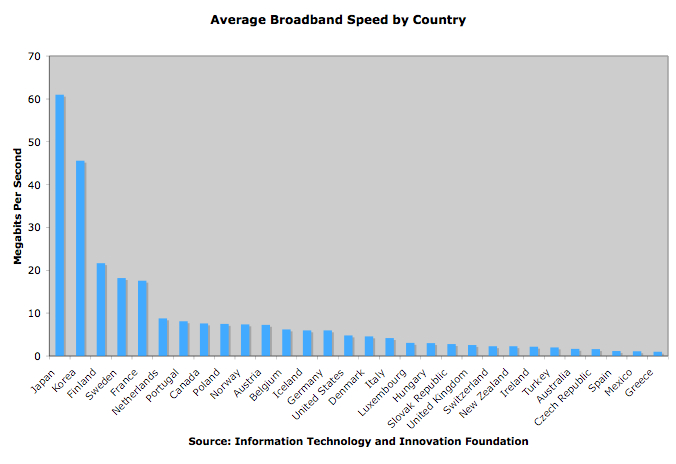
We also discussed Internet speeds across the globe. According to Jamaipanese.com, the United States places 23rd in the race for the fastest Internet speeds:
I was really shocked to find the United States ranked so poorly in regards to Internet speeds, especially because I actually believed that our Internet was relatively fast. While the WiFi capabilities on campus are less than stellar, I have never been disappointed by the speeds that I receive at my home. I cannot imagine how fast the Internet must be in places like Japan, Korea, and Finland.
In a YouTube video from Diggnation, the show's hosts discuss the differences between Internet speeds in Japan versus the United States. The hosts, who claim to be paying for speeds of 30 megabits per second, find that their speeds top at about 4 to 18 megabits per second. (Ignore the quirky behaviors and profanity.)
In searching for more information about Internet speeds, I found an article from February 2011 on the Huffington Post regarding the Internet in South Korea. According to the New York Times, as quoted in the article:
Overall, today's class enlightened me on just how behind the United States is with Internet technology. It's interesting to consider how often America is regarded as a "technologically-advanced" country, when in actuality, 22 other countries are racing right past us.
Today, FreePress.net lists six companies that control most of what Americans read, hear, and see in the media.
We also discussed Internet speeds across the globe. According to Jamaipanese.com, the United States places 23rd in the race for the fastest Internet speeds:
 |
| (click on the image to view it at full-size) |
I was really shocked to find the United States ranked so poorly in regards to Internet speeds, especially because I actually believed that our Internet was relatively fast. While the WiFi capabilities on campus are less than stellar, I have never been disappointed by the speeds that I receive at my home. I cannot imagine how fast the Internet must be in places like Japan, Korea, and Finland.
In a YouTube video from Diggnation, the show's hosts discuss the differences between Internet speeds in Japan versus the United States. The hosts, who claim to be paying for speeds of 30 megabits per second, find that their speeds top at about 4 to 18 megabits per second. (Ignore the quirky behaviors and profanity.)
In searching for more information about Internet speeds, I found an article from February 2011 on the Huffington Post regarding the Internet in South Korea. According to the New York Times, as quoted in the article:
"By the end of 2012, South Korea intends to connect every home in the country to the Internet at one gigabit per second. That would be a tenfold increase from the already blazing national standard and more than 200 times as fast as the average household setup in the United States."The article points out additional differences between the Internet in the United States and the services available in South Korea. While Americans pay an average of $46/month for "comparatively slow service," South Koreans "who enjoy above-average connection speeds of 100 megabits per second" pay just $38/month.
Overall, today's class enlightened me on just how behind the United States is with Internet technology. It's interesting to consider how often America is regarded as a "technologically-advanced" country, when in actuality, 22 other countries are racing right past us.
Tuesday, November 15, 2011
Ethics in Indy Journalism
Today's class focused on the ethics of independent journalism, and there were quite a few interesting points raised by Prof. Cohen and my classmates.
One of the biggest ethical dilemmas centered on Mayhill Fowler, a blogger for Huffington Post. Fowler gained access to one of Obama's political conferences that was closed to the mainstream media. After noting that others were recording the speech, Fowler broke out her own audio recorder.
During his speech, Obama referenced small town Pennsylvanians who become "bitter" and "cling to guns or religion" in response to the current state of our politics. Fowler caught it on tape, and realizing that Obama's comments could potentially be used against him, she published his entire speech so that readers could view the sentiments in their full context.
The dilemma is whether Fowler was ethically correct in recording the speech, let alone publishing it online.
I agree with many of the comments made in class regarding this issue. It is a journalist's duty to keep the government in check, not to protect politicians for fear of losing access to them. In this sense, I believe that Fowler did the correct thing by publishing the transcript.
I also agree with Prof. Cohen's argument that a politician should not be allowed to get away with saying one thing to one group of people, like large investors, and another thing to another group of people, like small-town voters. It's a journalist's job to make sure these types of discrepancies do not occur.
While Fowler took plenty of heat for publishing the article, I commend her bravery for both recording the speech and choosing to publish it online. I think her actions were admirable, and she certainly did the right thing by not burying the story merely because Huffington Post is so strongly pro-Obama.
Friday, November 11, 2011
Bloggers, Links and Plagiarism
Today, blogger Jim Romenesko — a staple at Poynter for over 12 years — resigned from his job after being accused of inadequately attributing quotes in his blog posts. According to Poynter's director, Romenesko would often copy and paste entire sections of news articles, and although he linked to the original sources, he did not enclose the copied information in quotation marks.
Bloggers and media critics have responded to Romenesko's departure with both harsh criticism and support. The response I found most interesting, however, came from Steve Buttry at the Journal Registry Company. Buttry argues that in an Internet era, linking to a source is the new in-text attribution.
The digital era is different, and I believe that it calls for us to reconsider the old habits and ideas of citations and plagiarism. In printed text, we can't link to sources. The ability to create a link, however, has revolutionized the idea of giving credit. Links create an easy-to-navigate, digital works cited page right within the body of the article or report. There's no need for messy parenthetical citations of authors, page numbers, and years, and no need to flip to the end of the report to hunt down a source.
It's simpler; it's cleaner; and it's certainly a lot easier to find the source of information.
Romenesko should have added quotation marks around the information he copied; it is the ethical thing to do, and it distinguishes between the blogger's voice and another author's writing. However, I agree with Buttry's standpoint: Romenesko's lack of quotation marks is not indicative of plagiarism, because he never failed to link to a source. His resignation over the matter seems like an extreme response to a minor offense.
Bloggers and media critics have responded to Romenesko's departure with both harsh criticism and support. The response I found most interesting, however, came from Steve Buttry at the Journal Registry Company. Buttry argues that in an Internet era, linking to a source is the new in-text attribution.
"I agree that Romenesko — and any journalist — should use quotation marks when using exact words of people. But when you credit and link, failure to quote is not plagiarism. It's a punctuation offense, not a serious breach of journalism ethics."At first thought, the idea of literally copying and pasting text from articles or sources seems like it warrants some sort of reprimand. We've been taught since we could write that all of the information that we use in papers and projects must be cited according to the rules of MLA or APA. Neglecting to cite information (or neglecting to use the appropriate commas and periods on the works cited page) constitutes plagiarism. Plain and simple.
The digital era is different, and I believe that it calls for us to reconsider the old habits and ideas of citations and plagiarism. In printed text, we can't link to sources. The ability to create a link, however, has revolutionized the idea of giving credit. Links create an easy-to-navigate, digital works cited page right within the body of the article or report. There's no need for messy parenthetical citations of authors, page numbers, and years, and no need to flip to the end of the report to hunt down a source.
It's simpler; it's cleaner; and it's certainly a lot easier to find the source of information.
Romenesko should have added quotation marks around the information he copied; it is the ethical thing to do, and it distinguishes between the blogger's voice and another author's writing. However, I agree with Buttry's standpoint: Romenesko's lack of quotation marks is not indicative of plagiarism, because he never failed to link to a source. His resignation over the matter seems like an extreme response to a minor offense.
Thursday, November 10, 2011
Good News for Net Neutrality
In Tuesday's class, we discussed the idea of net neutrality, a term that perhaps PC Magazine best defines:
So what's the good news?
In an article posted on the Washington Post earlier today, the Senate voted to uphold net neutrality, a huge victory for, well, basically everyone except the media conglomerates.
A level playing field for Internet transport. It refers to the absence of restrictions or priorities placed on the type of content carried over the Internet by the carriers and ISPs that run the major backbones. It states that all traffic be treated equally; that packets are delivered on a first-come, first-served basis regardless from where they originated or to where they are destined.It is interesting to consider how different our Internet experience would be were it not for this concept. The "Big Six" media conglomerates — General Electric, Walt Disney, News Corp., Time Warner, Viacom and CBS — dominate much of our online content; however, we still have equal access (at the same download speeds) to all other outlets, including independent media forms with opinions that may not jive with those of the Big Six. The absence of net neutrality would toss this equal access into question.
So what's the good news?
In an article posted on the Washington Post earlier today, the Senate voted to uphold net neutrality, a huge victory for, well, basically everyone except the media conglomerates.
Sunday, November 6, 2011
Legal Insurrection + Donation Buttons = ?
On Thursday, William Jacobson visited our class and discussed his blog, Legal Insurrection. During his presentation, a few students asked him questions regarding his blog's revenue model. While a small section of the right sidebar is devoted to garnering financial support from readers, the donate section is relatively hidden on the site; it appears at least a quarter of the way down the page and takes up only about an inch and a half of vertical screen space.
The donation buttons on other blogs and independent outlets are certainly displayed more prominently. Democracy Now! highlights its donations by making a separate tab for it in the top navigation bar; it's the only tab with a red background. A large green "DONATE" button graces the very top of Brave New Foundation's sidebar.
Darren Rowse at ProBlogger suggests that donation buttons are rarely successful on blogs, and their success is dependent on three criteria:
Perhaps the third point is most important, especially in the case of Legal Insurrection. Having an advertisement above the fold, as well as a few advertisements placed down the right sidebar, would certainly clue readers in to the blog's revenue model. This, in turn, might make them slightly less likely to financially support the blog.
I think that Jacobson is smart for placing his donation buttons so subtly on his blog; rather than throwing the idea of donations in the faces of his audience, readers can take notice of the blog's revenue model and then decide for themselves if they'd like to dish out cash.
The donation buttons on other blogs and independent outlets are certainly displayed more prominently. Democracy Now! highlights its donations by making a separate tab for it in the top navigation bar; it's the only tab with a red background. A large green "DONATE" button graces the very top of Brave New Foundation's sidebar.
Darren Rowse at ProBlogger suggests that donation buttons are rarely successful on blogs, and their success is dependent on three criteria:
- a very large readership – a small % will always be willing to donate but to get enough to live off you’d need a large readership
- a very loyal readership – obsessed readers who simply couldn’t live without the blog who were willing to dip into their own pockets to keep it running. Of course to get this high loyalty you need to provide readers with something that they can’t live without whether that be some kind of service or fulfillment of a need of some kind.
- no other forms of income – I think sites with lots of other income streams (advertising, affiliate programs) would be likely to see a decreased chance of readers contributing as there would be a perception that the blog was already making money
Perhaps the third point is most important, especially in the case of Legal Insurrection. Having an advertisement above the fold, as well as a few advertisements placed down the right sidebar, would certainly clue readers in to the blog's revenue model. This, in turn, might make them slightly less likely to financially support the blog.
I think that Jacobson is smart for placing his donation buttons so subtly on his blog; rather than throwing the idea of donations in the faces of his audience, readers can take notice of the blog's revenue model and then decide for themselves if they'd like to dish out cash.
Wednesday, November 2, 2011
Paywalls: New Adopters and "Sandbag Strategies"
In Tuesday's class, we talked extensively about paywalls, a way in which news websites restrict access to their content by "forcing" users to purchase an online subscription. As it turns out, it's simple to work around the block.
The New York Times may be the most well-known newspaper to enable the paywall blockade, and based on an article posted yesterday on Forbes, they might finally be reaping benefits: the Times reported that their home delivery circulation rose 0.2% over the last six months. According to the paper, this is the first time that circulation has increased in over five years.
Their success seems to be encouraging other news outlets to adopt a similar model. In an article posted yesterday on Fox 9 News, the Star Tribune — a newspaper that reportedly draws in 2.3 million readers to its website each month — has enacted a 20-article paywall, as well.
Mathew Ingram at Gigaom calls these paywalls "sandbag strategies" in that their ultimate goal is to increase print circulation and, in turn, hike up advertising prices:
...The biggest knock against the paywall is that it has virtually nothing to do with actually taking advantage of the digital world in any concrete way. It’s just charging people nickels and dimes for their paper, the way the NYT and other newspapers have for a century and a half or so. In that sense, it’s not really a strategy at all; it’s more like a line of sandbags designed to shore up the print business and squeeze as much money out of it as possible as it declines. A wise move? Perhaps. Something to get excited about? No.
Saturday, October 29, 2011
Police Brutality and YouTube
Earlier this evening, a friend of mine posted this transparency report from Google on his Facebook page. I was extremely intrigued when I read one of the bulleted items on the page:
Observations on Content Removal Requests
The fact that YouTube did not comply with law enforcements' requests is a huge victory for independent journalism. We've already heard cases this semester of citizen journalists capturing unethical or illegal police behavior; YouTube was often responsible for bringing the travesties to light. Kudos to the video-sharing website for protecting citizen and independent journalists over government and law enforcement agencies. Let's hope that these priorities remain even after YouTube begins offering mainstream-like television on its website next year.
- We received a request from a local law enforcement agency to remove YouTube videos of police brutality, which we did not remove. Separately, we received requests from a different local law enforcement agency for removal of videos allegedly defaming law enforcement officials. We did not comply with those requests, which we have categorized in this Report as defamation requests.
YouTube Jumping Ship to Mainstream Media?
Google has announced that its video website, YouTube, will soon add over 100 channels of original television programming. The company promises big names in its lineup, including Madonna, Jay-Z, and Ashton Kutcher. According to the Wall Street Journal article, the new television programs will offer over 25 hours of original programming, all available for free to Internet users.
YouTube's expansion into mainstream television begs to question if — and how — the website will change for citizen and independent journalists. Currently, YouTube allows anyone to post videos; those that go viral are featured on YouTube's homepage. This, in turn, exponentially increases the video's exposure. The formula has brought about immense social change in the past.
With YouTube pushing for more professional, mainstream television, will their homepage be infiltrated with sponsored programs, leaving average individuals without the opportunity to be seen and heard? Will YouTube convert to the "mullet strategy" — like the one used by the Huffington Post — where professional videos will be housed on the homepage and amateur videos will be hidden within the site? We won't know for certain until the channels launch next year, but I would bet that YouTube will certainly place priority on its multi-million dollar television deals over its non-profit posters.
Tuesday, October 25, 2011
Social Media Shutdown?
In today's class, we viewed a YouTube video of Asmaa Mahfouz, an Egyptian woman who posted a viral YouTube video calling for protestors to gather against Mubarak in Tahrir Square on January 25, 2011. Amy Goodman, of Democracy Now!, shows clips from the video on her program:
In class, we compared Mahfouz's video with "Common Sense," a pamphlet distributed by Thomas Paine in 1776 that condemned the British monarchy. There are certainly similarities, but perhaps the biggest difference is the way in which the protestors' information was delivered. While Paine relied on pamphlets to spread awareness of liberty, today's technology — such as YouTube, Facebook, and Twitter, for example — allows for viral videos and mass consumption at a much more rapid rate.
Brian Rank raised an interesting question in class: What would happen if these social media outlets were shut down in an effort to prevent viral videos from reaching the masses?
The shutdown is not impossible. In 2009, China shut down access to social media sites like Twitter, Facebook, Flickr and Blogger immediately before the 20th Anniversary of the massacres at Tiananmen Square. In January 2011, Egypt shut down "virtually all internet access" in an effort to control Mubarak's protestors. Libya, too, shut down internet access in February 2011 to keep protestors at bay.
According to an August 13, 2011 article on Wired, Britain is also considering a legal clause that allows the government to shut down social media websites in times of crisis. The reason, according to British Prime Minister David Cameron, is that social media often "[amplifies] panic, [spreads] misinformation and [causes] already-stretched police communications channels to be overloaded by people worried about some rumor they’ve read online."
It will be interesting to see how quickly a new method of dispersing information is developed in the event that the public is permanently disabled from using social media. In fact, I would bet that some of today's leading independent journalists have already considered this scenario. For now, we can only hope that our government does not follow along in other countries' footsteps.
Sunday, October 9, 2011
The Legacy of George Seldes
After reading Jeff Cohen and Norman Solomon's article, "Press Critic George Seldes Leaves a Legacy of Courage," I was intrigued by Seldes' determination as an independent journalist in the 1900s. The article mentions Seldes' attacks on the biggest press barons of the decade, including the well known William Randolph Hearst, for their "assisting [of] Hitler, Mussolini and Spain's Gen. Francisco Franco."
I searched YouTube and found an interesting video interview with Seldes that was filmed in January 1983. In it, the independent journalist discloses the exact role of the mainstream media in aiding Hitler.
It's fascinating to hear this account directly from Seldes, and I'm both impressed and inspired by his courage as an independent journalist. Based on our class discussions, it is evident that today's indy media journalists are aspiring to be — whether aware of it or not — in the same realm of Seldes in regards to publishing news free of government influence. I can only hope that this trend continues as our technology and resources evolve.
Wednesday, October 5, 2011
The Big Brothers of Blogging
An alarming article from the New York Times tells the shocking story of police officers hunting down French citizen Dominique Broueilh for commenting on a video clip of a French cabinet official with the simple words, "Oh, the liar."
It's a classic case of censorship and overwhelming government control, but its a paragraph that appears further into the story that really caught my attention:
It's a classic case of censorship and overwhelming government control, but its a paragraph that appears further into the story that really caught my attention:
Politicians here have filed lawsuits like Ms. Morano’s, organized in-house Internet surveillance teams — Mr. Sarkozy receives a nightly report detailing the day’s online chatter — and roundly denounced the Web as a breeding ground for disinformation.Internet surveillance teams? Nightly reports of online chatter? While the Web seems to be, at least for now, the French government's only target, it's terrifying to think about where these beginnings of government surveillance could lead to in the coming years. I can only hope that bloggers stay brave to keep it from further spiraling out of control.
Tuesday, October 4, 2011
Fashion Bloggers' Power Over Acclaimed Editors
In a time where blogs are popping up all over the web, it's an interesting debate as to whether or not those bloggers who rise to fame seemingly overnight should be given the same -- or even better -- treatment than those esteemed newspaper and magazine editors who claw their way to the top of the editorial food chain.
According to an article from the New York Times, Bloggers Crash Fashion's Front Row, young bloggers dominated 2009's catwalks by scoring front-row seats to the shows of some of the world's most elite designers. An even bigger blow? They were seated next industry experts (read: Anna Wintour).
In a country where the mainstream media have been slow to accept blogging, it is interesting that fashion designers and public relations agencies have been so quick to scoop up bloggers as some of the most influential writers and reporters of the 21st century. In the Times article, Kelly Cutrone, one of the industry's top publicists, best sums up the shift in power:
“Do I think, as a publicist, that I now have to have my eye on some kid who’s writing a blog in Oklahoma as much as I do on an editor from Vogue? Absolutely. Because once they write something on the Internet, it’s never coming down. And it’s the first thing a designer is going to see.”
Wednesday, September 14, 2011
Should We, As Journalists, Defend Julian Assange?
It's been a bit since we've heard anything major in the mainstream media regarding WikiLeaks or the scandalous activities of Julian Assange, but an article by Ben Adler posted last January on The Daily Base, Why Journalists Aren't Standing Up for WikiLeaks, has reignited my interest in this topic.
It's difficult to decide whether or not we, as journalists, should support Assange for exercising the freedoms of speech and press or condemn him for exposing confidential, critical documents related to our country's security and intelligence. According to the article, both Columbia University Graduate School of Journalism, one of the nation's top journalism universities, and the Society of Professional Journalists were unable to come to a conclusion as to whether or not Assange's practices were ethical (or legal, for that matter).
After reading the article, I agreed most with Adler's idea that journalists are hesitant to back Assange not because he exposed government secrets but because of the implications of him doing so. The article says:
Some journalists, while perhaps believing Assange should not be prosecuted, are so disgusted with his approach that they are reluctant to weigh in publicly. Sam Freedman, a journalism professor at Columbia University, did not sign the letter his colleagues circulated because, “I felt the letter did not adequately criticize the recklessness—the disregard for the consequences of human lives—of a massive dump of confidential info.” Freedman says prosecuting Assange would set a dangerous precedent for legitimate journalists. But many think, as Freedman does, that Assange did not exhibit the judiciousness that a journalist must when releasing classified information.As journalists, our role is to provide a check on the government by publishing information in a legally and ethically acceptable manner. While the information that Assange released into digital airwaves certainly shed a shocking light on the inner workings of our government, it put our country at an enormous risk for future attacks. I believe that a journalist's top priority should be the safety and well-being of our nation, and if publishing a story (or, in this case, a set of documents) jeopardizes those priorities on an exponential level, it should not be released to the public.
Monday, September 12, 2011
News 21 vs. Drudge Report
Surprisingly, I have never visited News 21, Brave New Foundation or Drudge Report as a primary source for gathering my news. I was shocked to find that News 21 was a student-run website, especially when comparing it to Drudge Report. News 21 has all of the ingredients for a well-produced, aesthetically-pleasing website. The content is simple to navigate and the Twitter ticker in the middle of the page is an added bonus.
News 21 does lack, however, in one major area: political news. As of today, September 12, the content on the website's homepage relates to a rise in job searching in Lehigh Valley, a report on food and health in the United States, and an article on coal as an energy resource. I could not find a single article on any politicians or legislation, but again, this was my first visit to the site.
Drudge Report, however, is drenched in political and international news; in fact, almost every story on the homepage falls into one of the two content areas, with today's headline news stating, "Italy Turns To China for Bailout."
I must admit that I found it difficult to spend a great amount of time on Drudge Report. With plain text, long lists and the only images being blocks of advertisements, I found the page messy and difficult to navigate. For now, I'll be sticking to CNN for my headline news and possibly News 21 for more in-depth reporting.
Subscribe to:
Posts (Atom)